
White Paper On Meta Earth Chain Bridge
1. Introduction
Since the launch of the main network of Meta Earth, network ecological users, community consensus, infrastructure and ecological applications are very weak and scarce. How to quickly break the situation from the current numerous public chains is the core concern of the current new public chain.
The value of the public chain determines the attractiveness of the network to the community, and the Dapp application carried by the public chain determines the value of the public chain. In the past many years, the blockchain network, whether it is social, gaming, or even gambling applications have not been developed on a large scale. At present, there are the most applications on public chains such as Ethereum, Cosmos,TRON, etc,The most extensive coverage of the crowd, the highest value. In order to quickly realize the layout of ME in the public chain ecology and enable existing Web3 developers to quickly enter the ME ecology, the current primary task is to realize the cross-chain requirements of assets based on Ethereum, Cosmos and TRON. Through the transfer of external high-value assets across the chain, activate ME-chain assets,Lay the foundation for the following Ecological Applications of ME and the developer community, so as to continuously increase ecological users and Ecological Applications, and finally realize the promotion of the value of Meta Earth public chain.
This cross-Chain Bridge product adopts a hybrid architecture design of "distributed repeater + smart contract adaptation", integrates core technologies such as distributed consensus and smart contract adaptation, and supports cross-chain interaction between mainstream public chains such as BSC and TRON and ME NetWork. Products with high security, high availability, high scalability and other core features,It can be widely used in multiple scenarios such as decentralized finance (DeFi) and non-fungible token (NFT) transactions, providing core infrastructure support for the collaborative development of the Meta Earth blockchain ecosystem.
2. Project background and industry pain points
Ecological Status of 2.1 Public Chain
Since the birth of Bitcoin, blockchain technology has developed for more than ten years and has formed an ecological pattern with public chains as the core and multi-chain states coexisting. At present, hundreds of public chains have emerged around the world. Among them, mainstream public chains such as Ethereum, Bitcoin, BSC, Solana, and Avalanche rely on their respective technical advantages and ecological characteristics,Occupy a major share of the market.
There are significant differences between different public chains in terms of consensus mechanism, transaction throughput, intelligent contract function, ecological application, etc.: Bitcoin has become the core carrier of digital asset storage due to its high degree of decentralization and strong security; Ethereum has become the main landing platform for DeFi, NFT and other applications with its perfect intelligent contract ecology;BSC, Solana, etc. have the advantages of high throughput and low handling fees, attracting a large number of users and developers to settle in. However, this "multi-chain coexistence" pattern has also led to ecological fragmentation, and it is difficult to achieve effective value transfer and data interaction between different chains.
2.2 The rise of cross-chain demand
With the continuous deepening of blockchain applications, users and developers have an increasingly urgent need for cross-chain interaction. In the field of decentralized finance, users hope to conduct unified management, cross-chain lending and trading of assets on different chains; In the field of NFT, creators and collectors need to realize the cross-chain circulation of NFT between different platforms; In enterprise applications, supply chain data under multi-chain architecture needs to be shared and verified across chains.
As a core solution to the problem of multi-chain isolation, cross-chain technology can break the technical barriers between different public chains and realize cross-chain interoperability of assets, data and contracts, thus promoting the coordinated development of blockchain ecology and expanding the application boundaries of blockchain technology. According to industry data, the global cross-chain transaction scale has exceeded 100 billion US dollars in 2024, Cross-chain infrastructure has become one of the core competitiveness of the blockchain ecosystem.
2.3 The limitations of existing cross-chain schemes
At present, a variety of cross-chain solutions have emerged in the industry, including hash locking, side chain/relay chain, distributed private key control and other types, but these solutions generally have the following limitations:
- Insufficient security: Some cross-chain solutions rely on centralized relay nodes or a single authentication mechanism, which has a single point of failure risk and is vulnerable to hacker attacks. There have been many attacks on cross-chain bridges in history, resulting in hundreds of millions of dollars in assets being stolen.
- Limited compatibility: Most cross-chain solutions only support the interaction of specific public chains, and the adaptation cost of new public chains is high, which is difficult to meet the diversified needs of multi-chain ecology.
- The performance bottleneck is obvious: some cross-chain solutions are limited by the consensus mechanism or technical architecture, and the cross-chain transaction throughput is low and the confirmation time is long, which cannot meet the needs of high-frequency trading scenarios.
- Single function: Existing cross-chain solutions mostly focus on asset cross-chain transfer, lacking support for complex scenarios such as data cross-chain interaction and smart contract cross-chain calling.
- Insufficient interoperability: The lack of unified technical standards and interaction protocols between different cross-chain solutions leads to the formation of new isolation barriers between cross-chain ecosystems.
Based on the above industry pain points, this project aims to develop a safe, efficient, compatible and multi-functional public chain cross-Chain Bridge product to provide core infrastructure support for the Meta Earth ecosystem.
3. Vision and Core Design Principles
Vision: become a "liquidity highway" that ME NetWork connects all public chain networks without trust, build a decentralized cross-chain infrastructure that "connects everything chain", break the ecological isolation barrier of multiple public chains, realize the seamless cross-chain interaction of assets, data and smart contracts, and promote the development of block chain technology to the direction of scale and synergy,Provide secure, efficient, and convenient cross-chain services for global users and developers of Meta Earth, enabling blockchain application innovation.
3.1 core principles:
- Safety first: the distributed repeater mechanism is adopted, and the cross-chain message mechanism can be guaranteed without trusting a single centralized node;
- Efficient and low cost: Optimize the verification process to achieve near real-time confirmation and low fees;
- Scalable and modular: support rapid integration of new chains and upgrade of future verification technologies;
- User experience first: provide a unified front-end interface and intelligent routing to achieve one-click cross-chain;
- Strong compatibility: assets can be transferred between popular public chains such as Ethereum, TRON, BSC, etc.
3.2 Core Value
- Break multi-chain isolation and realize value interoperability
Through this cross-Chain Bridge product, users can realize the safe and rapid transfer of assets from different public chains to the Meta Earth public chain. Developers can build cross-chain applications, break the asset and data isolation of multi-chain ecology, and promote the collaborative transfer of multi-chain value.
- Strengthen security and reduce cross-chain risks
Using multiple security technologies such as distributed repeaters and Multi-sign mechanisms, a high-security cross-chain architecture is built to effectively prevent security risks such as single-point attacks and data tampering, and ensure the credibility and asset security of cross-chain transactions.
- Improve cross-chain efficiency and optimize user experience
Optimize the data transmission process, realize low latency and high throughput processing of cross-chain transactions, shorten transaction confirmation time, reduce cross-chain handling fees, and provide users with a convenient and efficient cross-chain experience.
- Compatible with multi-chain ecology, with high scalability
Supports fast adaptation of mainstream public blockchains, and reserves new link-in interfaces to flexibly expand and support more public blockchains.
- Support for complex scenarios, enabling application innovation
It not only supports the cross-chain transfer of assets and Meta Earth, but also implements complex functions such as data cross-chain interaction and smart contract cross-chain calling, providing comprehensive cross-chain support for DeFi, NFT and other scenarios, and promoting the innovation and development of Meta Earth Ecological Applications.
4. Core technologies and principles
Meta Earth cross-chain bridge adopts the asset cross-chain process of "lock-cast-release": when the user cross-chain the asset (such as: USDT) on chain A (such as TRON) to ME NetWork, first lock the asset in the cross-chain contract of chain A, and after the repeater verifies the lock transaction,Cast the corresponding number of assets in the chain-end module of the ME NetWork; When the user cross-links the cast assets on the ME NetWork back to the chain, the mapped assets on the ME NetWork are also destroyed first, and the original assets on the chain are released after verification. The released asset corresponds 1:1 to the value of the original asset,Ensure value conservation across chain assets.
There are mainly the following processes and components:
4.1 cross-chain processes
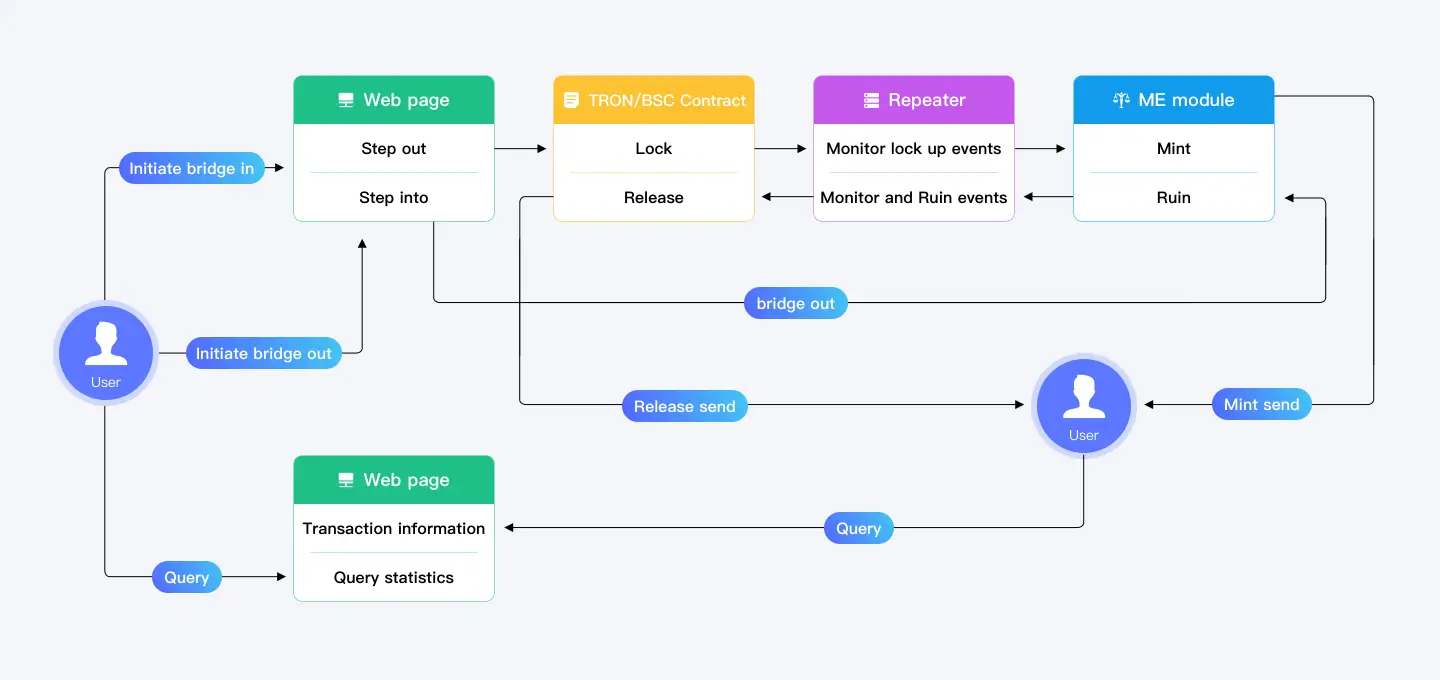
Process description:
- The asset owner (User) initiates a lock transaction across the chain through the Web-side application (applet/desktop application), locks the source chain (TRON/BSC) asset (USDC/USDT) on the smart contract of the cross-Chain Bridge, and specifies the recipient address of the Target chain;
- The repeater program gets the locked transaction event and does the following:
b1. The repeater program submits the coinage transaction to the Hub layer module of the Target chain Meta Earth;
b2. The underlying module of the Target chain Meta Earth performs coinage transactions, casting cross-chain asset currency (USDC/USDT), locking the number of positions and casting the number ratio of 1:1, and granting the recipient;
- The holder of the cross-chain asset (e. G. The same user address) initiates a cross-chain transaction to the cross-Chain Bridge through the cross-chain function of the Web-side application (applet/desktop application) and specifies the recipient's address;
- The repeater program obtains the cross-out transaction event and confirms that the Hub module of Meta Earth destroys the currency of the asset corresponding to the cross-out quantity;
- The repeater program initiates a release transaction to the cross-Chain Bridge smart contract of the source chain (TRON/BSC);
- The cross-Chain Bridge smart contract of the source chain (TRON/BSC) executes the release transaction, destroys the quantity and releases the quantity ratio 1:1, and transfers the specified quantity of assets to the recipient's address;
5. Finally, users can query cross-chain transaction dynamic information through Web applications.
Overall 4.2 Architecture
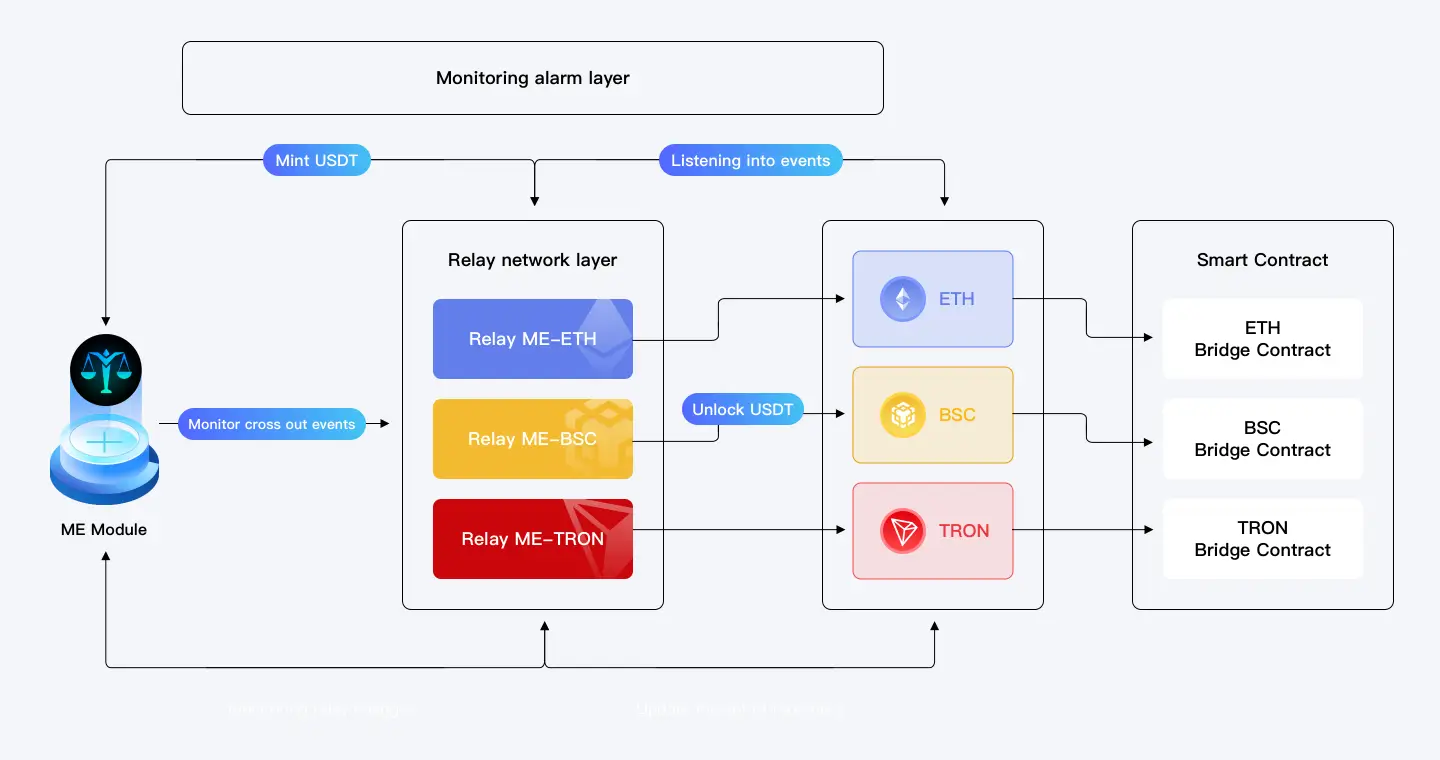
This cross-chain bridge is designed in a layered architecture, with the bottom module of ME, the relay system, the source chain intelligent contract layer, and the monitoring and alarm layer in sequence from left to right. Each layer has clear responsibilities and decoupled design, and realizes inter-layer communication through standardized interfaces to ensure the flexibility, scalability and maintainability of the architecture.
Detailed description of architecture layering:
- The bottom layer module of ME: the bottom layer of the Meta Earth Network, which is responsible for connecting different public chains, adapting public chain API interfaces and smart contract standards, and realizing cross-chain data access, cross-chain asset casting and destruction, format conversion and protocol adaptation.
- Relay network layer: a cross-Chain Bridge builds a distributed repeater cluster, which is responsible for monitoring public chain events, transmitting cross-chain data, and synchronizing cross-chain states. It is the core channel for cross-chain information interaction, ensuring the reliability and efficiency of data transmission, and is the basis for the interaction between Meta Earth Network and other public chains.
- Smart contract layer: Smart contracts deployed in the source chain, including asset locking, asset release, cross-chain verification, etc., are the execution carriers of cross-chain operations and realize the automatic execution of cross-chain logic.
- Monitoring and alarm layer: The top layer is responsible for monitoring the running status of each module of the cross-Chain Bridge, the execution status of cross-chain transactions, and the health status of nodes, triggering abnormal alarms and generating monitoring reports to support O & M decisions and troubleshooting.
4.3 Cross-chain contract
A cross-chain contract is a smart contract deployed on each public chain. It is responsible for locking, mapping, and unlocking assets, as well as initiating and receiving cross-chain transactions.
This solution uses the scalable EVM contract model development framework to adapt to the smart contract syntax and virtual machine architecture for different public chains for customized development, to achieve seamless connection between cross-chain bridges and public chains, and to support cross-chain calls and data interaction of smart contracts.
4.4 Decentralized Repeater
This solution uses a decentralized repeater cluster to manage cross-chain contracts. The de-Sinochemical repeater cluster handles the initiation, verification, routing, and execution of cross-chain transactions to achieve standardized output of cross-chain functions.
Repeaters can only be added or changed through Meta Earth DAO address plus white list or on-chain proposal. Only the proposed relay address can pledge MEC on-chain and become an official repeater. Repeater cluster through the chain pledge weight rotation, only by adjusting the repeater address of the pledge MEC can change the round.The benefits of this are:
- Even if the service of individual repeaters is offline, it will not affect the operation of the cross-Chain Bridge;
- Even if the private key of the individual repeater address is stolen or lost, it does not affect the overall security of the cross-Chain Bridge. Because the evil relay can be punished and put forward the repeater cluster because of the pledge. The administrator can replace the repeater through the on-chain proposal and kick the stolen repeater out of the cluster.
- The repeater obtains weight by pledging MEC, and a cross chain transaction requires 2/3 weight confirmation to be confirmed.
- The private key of the relay is isolated from the relay service, and remote signatures are used to prevent the relay service from being attacked and causing private key leakage.
4.5 Chain Management Desk Module
The management platform module is responsible for the ecological management of the public chain supported by the cross-Chain Bridge, including functions such as new link entry, chain status monitoring, and chain parameter configuration. Provides a standardized new link entry process. Developers can quickly access the new public chain through the chain adaptation layer. Real-time monitoring of the running status of each chain and the working status of cross-chain nodes ensures the stability of cross-chain services.
5. Economic model design
5.1 Cross-chain fee mechanism
In order to ensure the sustainable operation of the cross-Chain Bridge, a certain cross-chain transaction fee will be charged. The handling fee mechanism is designed as follows:
- When to pay: Cross-chain handling fees are mainly used when Meta Earth enters TRON or BSC, and the paid repeater calls the smart contract.
- Dynamic Handling Fee: dynamic handling fee, which is adjusted according to the complexity of cross-chain transactions and the congestion level of the source chain network (TRON or BSC).
- Payment Method: mainly uses cross-chain currencies such as USDT and USDC as payment methods to provide basic operating costs for cross-chain bridges.
5.2 Cross-chain coinage scheme
To support the Meta Earth community ecosystem application and facilitate cross-chain asset transactions, the mapping relationship between Meta Earth cross-chain coin and source chain (TRON/BSC) token assets is as follows:
| Source Chain | Assets | Corresponding Meta Earth assets |
| TRON | USDT-TRC20 | USDT |
| BSC | USDT-BEP20 | |
| TRON | USDC-TRC20 | USDC |
| BSC | USDC-BEP20 |
- After BSC USDT and TRON USDT cross to Meta Earth, they use a unified symbol, which is defined as USDT;
- After BSC USDC and TRON USDC cross to Meta Earth, use the same symbol, which is defined as USDC;
6. Safety Design
6.1 attack protection strategy
In view of the common attack methods in the public chain industry, a perfect attack protection strategy has been formulated:
- Single-point attack protection: The repeater node is deployed on distributed nodes, and the core service of the cross-Chain Bridge has no single-point dependence on the verification node. Even if some nodes are attacked, the system can still operate normally.
- Replay attack protection: assign a unique transaction ID and timestamp to each cross-chain transaction. The verification node rejects repeated transaction requests to prevent replay attacks.
- Contract vulnerability protection: Cross-chain contracts go through multiple rounds of internal security audits to ensure the correctness of contract logic. At the same time, an emergency suspension mechanism is set up to quickly suspend contracts when vulnerabilities are found to avoid asset losses.
- DDoS attack protection: uses the distributed denial of service (DDoS) protection system to monitor network traffic in real time and block abnormal attack traffic to ensure network security and service stability across the Chain Bridge.
6.2 Safety Considerations and Risk Mitigation
- Vulnerability Bounty: Fully open source, subject to community review. Set up a high-value, long-term vulnerability bounty program to encourage white hat hackers to find vulnerabilities;
- Hardware security module: the private keys of Repeater Nodes are all stored in the HSM hardware security module, which ensures that the private keys never reach the server memory and fundamentally prevents the key leakage caused by the server being invaded;
- Cross-Chain Bridge monitoring mechanism: 7x 24 monitoring of the bridge's contract lock balance, cross-chain transactions, repeater signature activity, repeater service status, etc.
- Emergency response mechanism: establish a security emergency response team and formulate emergency plans. When a security incident occurs, the emergency process can be quickly started, and measures such as suspending services, freezing assets, and repairing loopholes can be taken to reduce losses.
- Security update mechanism: Regularly update and upgrade the core code, contract, and security components of the cross-Chain Bridge, adapt to the latest security technology and protection methods, and improve the security of the system; Regularly rotate the repeater key and formulate a detailed emergency plan for key leakage or loss.
7. Anti-Money Laundering
With the continuous increase in the penetration rate of cross chain technology in the encrypted asset ecosystem, cross chain bridges have become the core infrastructure for connecting the circulation of multi chain assets. However, they have also been used by illegal elements as tools for cross-border fund transfer and identity concealment. According to the report "2025 Cross Chain Crime Status" by Elliptic, the scale of illegal assets laundered through cross chain services has reached 21.8 billion US dollars, an increase of 211% compared to 2023. Among them, 33% of cases involve three or more blockchains, and cross chain money laundering risks have become a core challenge that cannot be ignored in the industry.
The Meta Earth cross chain bridge regards pre transaction risk control as the core link of the anti money laundering system. Through deep integration with the Chainalysis platform, it constructs a three-level pre risk control mechanism based on KYT risk intelligence, which includes "address label verification, multi-dimensional risk scoring, and automatic strategy decision-making". All cross chain transactions must complete Chainalysis risk verification before entering the cross chain processing flow, blocking illegal fund flow from the source.
- Deep integration of Chainalysis address tag library: Abandoning the self built tag library model, fully reusing Chainalysis' massive global address tag resources, covering 12 major categories of risk tags such as sanctioned entities, hacker groups, cryptocurrency mixing services, dark web markets, and high-risk exchanges. The tag library is updated in real-time by Chainalysis' on chain intelligence network (update delay ≤ 1 hour), ensuring rapid coverage of emerging black industry addresses and solving the pain points of untimely and incomplete updates of self built tag libraries.
- Chainalysis Multi dimensional Risk Rating Driven Decision Making: Integrating Chainalysis KYT's 0-100 point risk rating system, generating rating results based on historical interaction behavior, associated risk entities, asset flow paths, and other multidimensional data of both parties' addresses. Setting a three-level decision threshold: rating ≤ 40 points (low risk), direct release is granted; 40-60 points (medium risk) trigger enhanced information verification; Automatically block transactions and push alerts with a score of ≥ 60 (high-risk),synchronously obtain Chainalysis' risk score details, and provide a basis for manual review.
The Meta Earth Cross Chain Bridge project is supported by Chainalysis platform as the core compliance technology, which integrates pre transaction risk control throughout the entire process of anti money laundering system. It relies on Chainalysis' industry-leading on chain analysis capabilities and combines cross chain technology characteristics to build a compliance system that can effectively block illegal fund cross chain circulation while balancing compliance efficiency and user experience, promoting the large-scale application of cross chain technology within the regulatory framework. In the future, the project will continue to deepen its cooperation with Chainalysis, synchronously iterate risk screening strategies, adapt to changes in regulatory policies and black industry practices, and create a benchmark for safe and compliant cross chain infrastructure.
8. Roadmap
- Phase I: Basic Start-up (2025 Q4 - 2026 Q1)
- Complete the cross-Chain Bridge applet version between TRON and BSC Chain and ME NetWork;
- Release of the white paper on the cross-Chain Bridge protocol.
- Phase II: Version Extension (2026 Q2 - 2026 Q3)
- Implement multi-chain architecture and support multi-span chain bridges of Ethereum public chain assets such as ME NetWork, Arbitrum,Polygon, and Avalanche;
- Support Web-side cross-chain;
- The third stage: ecological construction (2026 Q4 - 2027 Q1)
- Support cross-chain transactions between ME and public chain assets such as XRP and Cosmos;
- Support NFT asset cross-chain;
- Optimize product functions such as management desk and Web side.
- Stage 4: Decentralization and Innovation (2027 and Beyond)
- Explore more advanced verification techniques such as ZKP verification;
9. Conclusion
The Meta Earth cross chain bridge protocol, through its innovative decentralized and modular architecture, interfaces with the Chainalysis platform, providing a powerful, secure, anti money laundering, and future oriented solution to the core challenges of multi chain interoperability. We believe that a truly decentralized, efficient, and universal cross chain bridge is the key to unlocking the full potential of blockchain. Meta Earth Cross Chain Bridge is committed to building this critical infrastructure and driving the evolution of Web3 towards a seamless interconnected .